Sound Design For Adaptive Context
ROLE
Recording Engineer, Play Tester & Sound Designer
Assignment Brief
Your Sound Manipulations and Soundscapes should evidence the Sound Design techniques used across both works: sound manipulation, synthesis, sampling, audio editing and effects processing as well as the key sound recording techniques you have employed. Your work is required to evidence effective management of your production processes, and individual workflow for each work demonstrated through your compositional arrangement contexts reflecting professional practice appropriate to the medium.

YEAR
2022
Equipment
TASCAM DR-40X PORTABLE DIGITAL RECORDER
PLATFORM
Logic X, Unity
My Project
MTV1 Ident
An ident is a brief sequence that identifies the station on television between programmes. I was tasked with producing an ident for a visual work of my choosing. With this in mind, I had to make all the noises or music, and precisely align the audio with the right graphic element, a process known as "spotting." You may watch my ident in the video posted above.
For my ident, I decided to use the MTV clip because of its bright and colourful aesthetic. This presented me with many textures I could work with. I set in mind that the video was actually three idents, so planned to create different styles with each but remembering that it was best to make sure they worked together. Using the marker tool I realised that the scenes did not line up on the beat, so by marking them out meticulously I could better adapt my style which came most into play with the second scenes transitions. With many hours in my adolescence watching music channels I set to work planning my scenes.
The first was to be reminiscent of a live sound performance or sound check based more towards a rock setting, this to me felt like more of a call back to the early days of MTV when rock music was more popular with its demographic. I designed scene one mainly with items found around my house, using plug-ins for the amped noise of the guitar through direct input, I managed to record an effective fuzz. This coupled with a Tascam DR-40X in X-Y mode, I could stand at a good range to get a clear cough recorded helpfully by my partner. Then I added a small reverb to give the sense of an empty concert area. This just left me with the sound I would create for the logo appearance.
With the third I decided to mix with a little more of a satirical side, this to show as much as the company knew what it was. It knew what its audience was, the modern adolescent. Next I decided to create scene three. With the idea that a melody would play over the falling balls, I found myself not needing to worry so much about timing, only to make sure that it fit with the logo. I formed a small 2 bar riff that I could descent over the last half bar with the ES1. This was to give a sense of completion to its course whilst I had a running bass create the tempo. This then gave me the idea for the glockenspiel sound by layering alchemy as well as sampler to create a more unique tone for the logo pop up, copying the chord used on guitar for scene one.
The last one I decided to mix with a little more of a satirical side, this to show as much as the company knew what it was. It knew what its audience was, the modern adolescent. With this now in hand my last focus was to properly tune a light white noise effect, with automation, to pan across the numbers as they changed by precisely spotting the frame. This left my video off time with Logic’s markers, so I played by my own rules and devised a sound that would make sure cut off before the next notes played, however not too harsh that it made the scene feel disjointed.
Audi Car Advert
When it came time to create my Audi A1 advertisement, I expanded upon the techniques I used for my ident. With the four major areas in mind, when dealing with visual media:
Dialogue – commonly the main narrative of film and television.
Effects – sounds that emerge from the actions of the characters within the story
Ambience – the sound of the environment and scene in which it takes place
Music – adds emotion to the tone of the scene and is another element of storytelling
All these components are crucial to the work that I have been doing, but when it came time to produce the advertisement I focused mainly on the music, ambiance, and sound effects.
Spotting is a technique extensively employed in the television and film industries and pertains to the placement of audio in relation to visual action. As I had to build every single sound effect myself, I found my cue sheet using markers on Logic to be more useful, as it had a direct link to its frame and helped me recall where I had to time the Foley. When handed the advertisement, it was evident that there were several features and noises to be captured. To preserve efficiency and stay on top of the sounds, I created a Foley sheet (like a cue sheet) that enabled me to identify each component that still required recording, as I had written down upon watching the scene for the first time. A cue sheet is created in accordance with the Society of Motion Picture and Television Engineers (SMPTE) timecode, which is a highly exact kind of timing for sequences throughout a visual work and corresponds to frames per second.
I produced several of my noises with household materials. For example, for the birds I utilised paper flapping and added a high cut filter to create the sense that they were farther away and that their sound was muted. To create the effect of rabbits eating, I filmed myself opening and shutting my lips at a loud volume on a Tascam, which was then edited by various space designers across the two scenes as the camera moved. To tie together all the parts, I composed a midi drum track with an offbeat pace, largely based on David Bowie's "Black Star" track, to give the sense of an avant-garde performance that would complement the black and white aesthetic of the piece.
To round off my advert I added a subtle ES1 synth to ident to give a similar iconic sound to a true Audi advert. The advert can be seen above upon YouTube.
Non-linear defines anything that is neither sequential nor comprehensive. A video game, for instance, is a non-linear interaction since the user's experience varies with each play-through and decision. In direct opposition, a film or novel is a linear journey since it is same each time it is seen or read.
Brian Eno, a pioneer of ambient music, made an album titled "music for airports." One track was constructed in a particularly intriguing manner, as shown by the following comment from his 1996 lecture in San Francisco which depicts his method for creating "2/1" (Eno, 1978)
‘…at least one of the pieces on there, is structurally very, very simple. There are sung notes, sung by three women and myself. One of the notes repeats every 23 1/2 seconds. It is in fact a long loop running around a series of tubular aluminium chairs in Conny Plank's studio. The next lowest loop repeats every 25 7/8 seconds or something like that. The third one every 29 15/16 seconds or something. What I mean is they all repeat in cycles that are called incommensurable -- they are not likely to come back into sync again’ (Eno, 1996)
This would be my inspiration behind the how I tried to seamlessly change the dynamic for my games music whilst the character proceeded to pass through different biomes by reducing the volume of certain instruments and replacing them with new themes that accompanied the overall tone.
Terraria is a sandbox side scrolling 2D action-adventure game that was launched for the first time in 2011. This enormously popular game has sold over 40 million copies all over the globe and is renowned for its sandbox gameplay components. The gameplay is
reminiscent of classic 16-bit games, the likes of which might have been found on the NES. However, the visuals and capabilities of the NES have been updated to reflect the advancements in technology. The player is provided with several layers of tiles that may be altered to transform the landscape around them, create pixel art pictures, and build houses with extravagantly detailed interiors in which to survive. For this, it has been compared to Minecraft on account of the fact that the player is the only one who can restrict the game's capabilities.
For this reason, my plan was to create as many effects as I could using the ES1 built in synthesiser for Logic. Reminiscent of my subtractive synthesis work for earlier in the year, I knew how I wanted to focus on certain sounds, whilst leaving some more background and repetitive sfx out as to not over saturate the player’s experience. The video was a recording of myself streaming on twitch briefly.
My first concentration was directed on the opening, which consisted of a brief loading screen lasting ten seconds and being shown at the beginning of the broadcast. I had previously developed a melody that I had planned to utilise on another project, and for this, I decided to reduce it down to the phasing bass line to provide a feeling of suspense. This was then quickly faded out when the screen changed to a menu. This meant that to generate the sound I was going for, I was going to have to alter the pace of this rhythm. This caused havoc with the markings I had previously created for the parts but thank goodness I was still able to retrieve my timings thanks to the cue sheet I had produced.
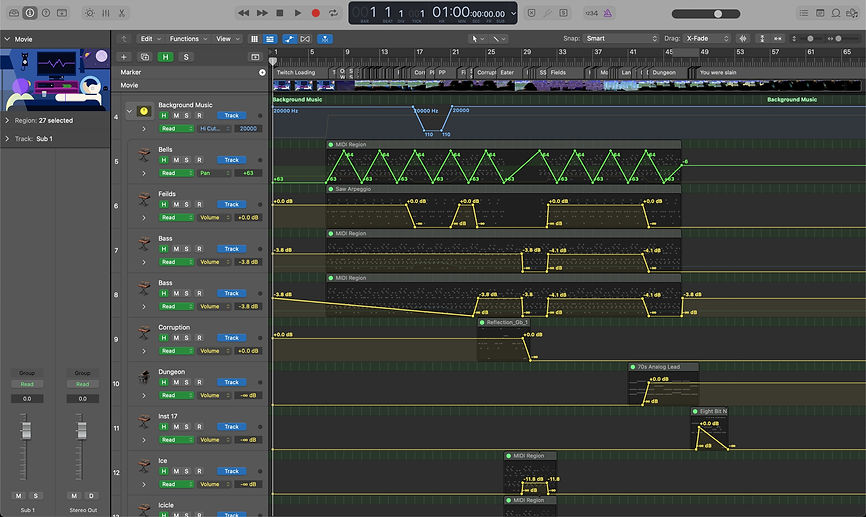
By using cut-off and automation, I was able to make the music seem more muffled; this was my favourite aspect of the soundtrack that accompanied the player as they went underground. In an ideal scenario, this would include either introduce playing a new piece that was based on the same structure as you progressed further down the level, or it would involve creating a new melody in response to the biome that the player was now discovered in.
In order to provide a more realistic impression of the mob, I panned the effect of specific creatures as they moved across the screen due to the player whizzing overhead. It would be ideal for this to be a sound that was activated by its arrival on screen and that was tied to the sprite itself. The panning, which was determined by which side of the player it resided, would then impact the nature of the sound. This is something that is often used in 3D games in order to give the setting a sense of actual space; the fact that it is not utilised more frequently in games such as these may be seen as a stylistic decision on the developer's part. On the other hand, I believe that this gave my portrayal an appealing touch, allowing me to feel a stronger connection to the player and the environment.
References
Eno, B. (1978). 2/1. Editions EG.
Eno, B. (1996). Generative Music - Brian Eno - In Motion Magazine. [online] Inmotionmagazine.com. Available at: http://www.inmotionmagazine.com/eno1.html