Sound Design For Creative Capture
Role
Programmer, sound manipulator, researcher
Assignment Brief
To collaborate with class members in a genre fusion EP that explores current affairs.
YEAR
2022
Collaborators
Mattia Taraschi
Joseph Kirkendall
Jaheim Sturt
Platform
Logic X
Industrial Lo-Fi
Vapor Stacks
After having made the decision to make an EP that combined the elements of Industrial and Lo-Fi music, the group began conducting research into both genres to acquire greater clarity in the overall sound that they intended to accomplish. We decided to centre the entire EP on the idea of pollution and climate change so that the flow would be consistent from song to song. The lo-fi component was supposed to evoke a more tranquil, day-to-day sense of wellbeing, while the harsh contrast of the industrial parts was supposed to be a representation of the worldwide situation that we are currently confronted with.
The term "lo-fi" is an acronym for low fidelity and is the antithesis of "hi-fi" productions, which is abbreviated from high fidelity. Originally, the term "lo-fi" referred to a recording that was not up to the standards of a professional studio, containing low quality and audible defects, such as background noise or performance faults. Similar to hip-hop, modern lo-fi relies heavily on drum loops to create its rhythm. Lo-fi utilises both electronically produced samples and live drum sounds. However, beat makers favour live components given that they are simpler to control in a
digital audio workstation (DAW). Typically, tracks are in the low to mid-tempo range, between 70 and 90 beats per minute (BPM). Jazz chord progressions play a vital role in many lo-fi tracks due to their laid-back and reflective nature. Lo-fi musicians may also use horns and guitar, depending on the composition, in addition to rhythmic samples (bass and drums) and piano. Even though lo-fi music is primarily instrumental, many lo-fi tracks include samples and other effects to support the music. Numerous vocal samples are drawn from anime to show the relationship between the two media. Additionally, the crackling of a vinyl record is sometimes used to represent the warmth and sentimentality of an analogue recording.
J Dilla is considered a pioneer of lo-fi hip-hop owing to the fact that his sound contained lo-fi characteristics and his techniques/instruments have been significantly embraced by the lo-fi hip-hop community. His samples were soulful and jazzy, and his beats were laid-back. Due to his decision to bypass the quantization function of the MPC-3000 and to generate rhythms that were slightly off, he gave his music a "human" and relaxed quality. The sound was not perfectly robotic but allowed for some freestyle. Today, Lo-Fi is usually associated with words such as "study music." This is partly because YouTube channels like as ChilledCow initiated the trend of study music livestreams towards the middle of the 2010s.
People began to view lo-fi as a quick route to popularity, rather than with the passion and soul on which it was originally founded. As copyright holders became increasingly aware of the lucrative potential of the genre, sampling was gradually eliminated from songs because of its sudden rise in popularity.
The critic Simon Reynolds famously compared becoming a Throbbing Gristle fan to "enrolling in a university course of cultural extremism." This aptly describes the origins of industrial music. Clanging metal, harsh noise, heavy pulsing rhythms —this is how we often understand industrial music with Throbbing Gristle, who coined the word "industrial," emerging from the psychedelic rock scene as a performance art ensemble. One need only listen to the group's famed death drone "Slug Bait" once to grasp the essence of industrial music: the collision of musical extremes and societal taboos.
Since Throbbing Gristle's emergence in the 1970s, the
sound and form of industrial music has changed and evolved in infinite ways, to the extent that the genre's name is frequently misunderstood as a descriptor of its sound. Industrial music's impact might be heard in pop music such as Janet Jackson's Rhythm Nation 1814 and eventually in hip-hop. The progression of industrial hip hop was facilitated by personalities from a variety of contexts. Young Black Teenagers' 1991 self-titled first album featured an industrial-influenced sound that was produced by Public Enemy's Bomb Squad.
Prior to the partnership, we identified each member's individual skills.
-
Heavily influenced by Noise music, Jaheim. This influence would be crucial for the EP's industrial and harsher metal aspects.
-
Experienced with sampling and rhythm production in Logic X, Joe's skills would enable us to create the appropriate tones for the modern lo-fi aspects.
-
Mattia possesses experience manipulating sounds and samples to generate new textures.
-
With my solid understanding of composing via midi, we believed it would be useful for genre blending.
As demonstrated in the presentation, we agreed early on to divide the three tracks amongst ourselves, but with only two individuals working on each track. As the production continued, however, we realised that this strategy was not as collaborative as we had anticipated. Consequently, we began adding new ideas to each song separately, but the basic compositions remained divided among the original composers.
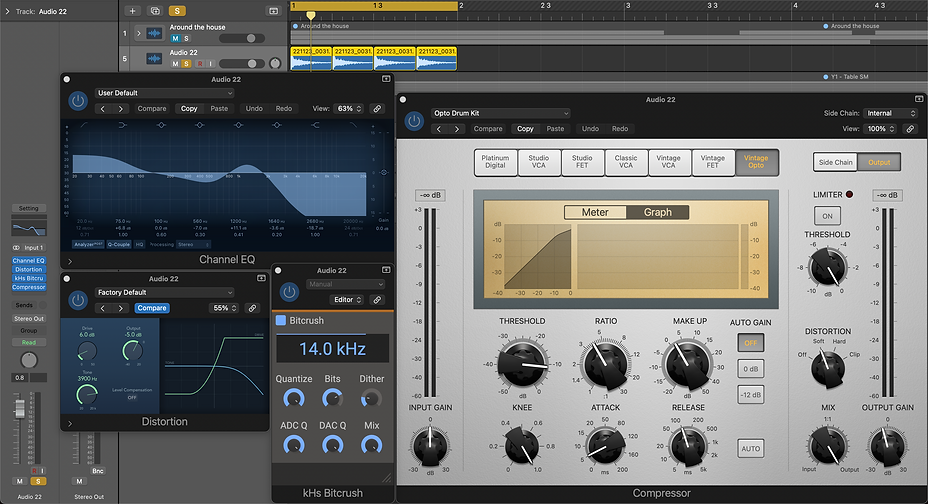
I came up with the ideas for "Ignoring The Problem" on my own during a Discord group call with everyone else. I examined 'Masters of Hardcore' highlight videos to imitate the composition and structure, pulling inspiration from rave and hardcore music. This motivated me to scour my home for objects that could serve as percussion instruments. Applying the construction of my TV cabinet door, the magnet clasp produced a mid-range snare tone by rattling the mesh, while modifying the recording allowed me to make a lower bass tone through manipulation. This was achieved by filtering out the higher frequencies with the Channel EQ to prevent other effects from emphasising the stronger ringing, and by boosting all frequencies below 75Hz to emphasise the bass. This meant that when I applied distortion to the top tones, I still had drive and a full timbre at the bottom. Using KiloHearts Bitcrusher @ 14Khz, I was able to suppress the noise while preserving a unique tone and a low-fidelity aesthetic, this caused a huge attack spike, which I addressed with Logic's drum kit compressor pre-set. This was then transferred from one project to another in order to keep my session organised, at which point I proceeded to work on the bell's metallic sound.
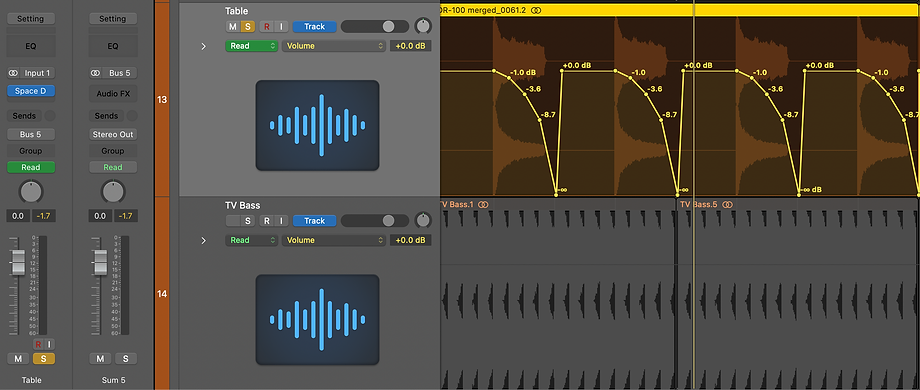
I knew that my attention would be on the interaction between the synchronistic call-and-response of the kick drum and other metallic parts due to the influence of production sounds in industrial music that I listened to as a child. Despite the fact that I was looking for new elements to record, I was pulled to the acoustics of a previously unused audio for my sound manipulation project. This was captured with a Tascam on campus, where I struck a metal table I found on our university grounds. Using a soft xylophone mallet, the welded-together table resonated somewhat like a bell when struck with a mallet. Due to this, I determined that the resonance was too long to use; however, this was remedied by manually automating the volume cutoff.
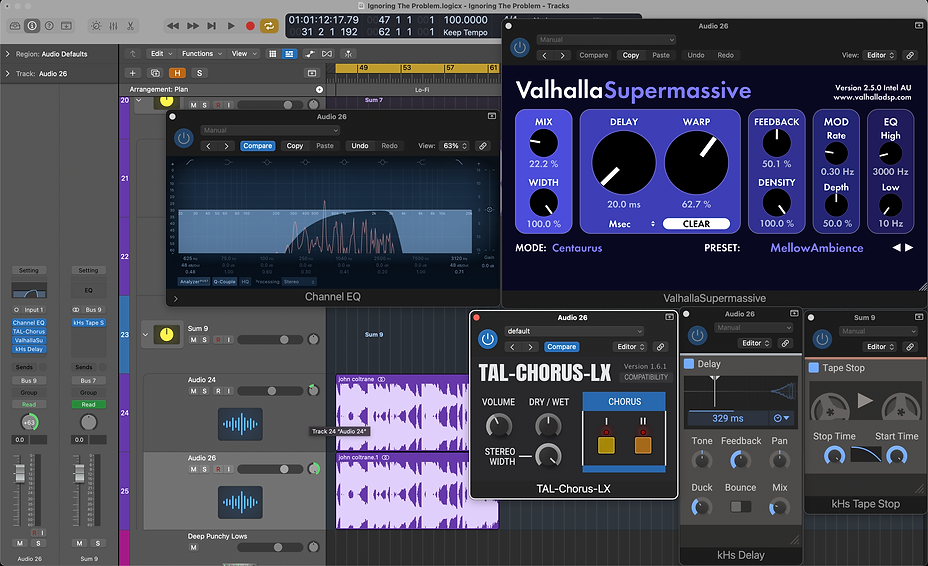
Joe collected a saxophone sample from John Coltrane's "Theme For Ernie" without paying heed to the tempo or key of the remainder of the song, creating a juxtaposition of disregard for the importance of the prior tones. The song's tempo is 59 beats per minute, giving the section a more relaxed feel. By modulating the loop like a tape machine and emphasising frequencies between 600Hz and 2KHz with a high-pass and low-pass filter, I aimed to convey a sense of floating through issues. With the inclusion of TAL-CHORUS-LX, Valhalla Supermassive, and kiloHertz Tape Delay to the right channel, I attempted to imitate the sense of a speaker heard in supermarket-style music that repeats endlessly until it warps. With the addition of Mattia's VCV-produced polyphonic sounds, I panned the element across the full lo-fi section while tightening and releasing the low-cut filter to create the illusion that it circled the listener. Overall, this provides the lo-fi portion a similar feel to the notorious "lo-fi girl" stream while employing a radio-like sound. This is then finally interrupted with Mattia’s introduction to another VCV sound to give an impression of the song speeding back up to it’s prior 100bpm tempo for the final loop of the main section before the outro.
In addition, I incorporated genre tropes from Studio Ghibli's "Nausicaa Valley of the Wind" into Joe's song "Can't run forever" with its theme of pollution. As this song contains a greater lo-fi aesthetic than others, I felt that its inclusion was appropriate for modern lo-fi, as it strongly incorporates pop culture and anime samples that lo-fi strives to replicate in its aesthetic. This was then layered on top of the introduction with a VCV-generated droning noise, giving the sense of tape degradation and modulated wind.
After receiving recognition for our mixing expertise, we collectively decided to rough-master our EP before
publishing it on Soundcloud. For this process, I worked closely with all group members to ensure that everyone was satisfied with the final product, resulting in an EP that is consistent throughout and that each group member enjoys.
Overall, working as a group was a terrific method for ideas to reach their full potential, since everyone contributed significantly to the creation of something new, hence promoting the usage of new production techniques, as we would ordinarily compose music alone. Although there were a few initial disagreements over ideas, concessions were reached. We ensured that we overcame any obstacles as a team and fought to produce a body of work that we believe meets the criteria we established. Effectiveness was achieved by outlining everyone's individual capabilities prior to any sessions, which allowed various tasks within partnerships to be assigned to specific individuals and performed to the best of their abilities. This was fantastic to then see performed in a live environment to our peers as we overcame our reservations together of listening to our music in a live environment at the student union bar. I feel that the group project was a lot of fun and has led to the planning of other collaborations inside the group, allowing us to develop and transform our own ideas into something new once again.
References
Chin, M. (2022) Lo-fi music: How it became an internet phenomenon, the connection with anime and more burning questions answered, BURO. Available at: https://www.buro247.my/culture/music/lo-fi-how-it-became-a-global-phenomenon-the-connec.html (Accessed: December 13, 2022).
Class, M. (2021) Lo-Fi Music Guide: History and characteristics of lo-fi music - 2022, MasterClass. Available at: https://www.masterclass.com/articles/what-is-lofi-explained (Accessed: December 13, 2022).
Harper, A. and Harper, A. (1970) Lo-fi aesthetics in popular music discourse, ORA. University Of Oxford. Available at: https://ora.ox.ac.uk/objects/uuid:cc84039c-3d30-484e-84b4-8535ba4a54f8 (Accessed: December 13, 2022).
iCouldBeYu (2022) J Dilla: The godfather of lofi hip hop, LoFi Weekly. Available at: https://www.lofiweekly.com/2022/02/03/j-dilla-the-godfather-of-lofi-hip-hop/ (Accessed: December 13, 2022).
Industrial hip hop (2022) Wikipedia. Wikimedia Foundation. Available at: https://en.wikipedia.org/wiki/Industrial_hip_hop (Accessed: December 13, 2022).
staff, T. (2022) A history of industrial music in 45 songs, Treble. Available at: https://www.treblezine.com/history-industrial-music-best-tracks/ (Accessed: December 13, 2022).